

Introduction to Tribes of Jharkhand
Jharkhand, known as the "Land of Forests," is home to 32 recognized Scheduled Tribes (STs), constituting around 26.21% of the state's population. These indigenous communities have a rich cultural heritage, distinct languages, and diverse traditions. The major tribes of Jharkhand include the Santhal, Munda, Oraon, Ho, Kharia, Bhumij, Kharwar, and Birhor, among others.

Classification of Tribes in Jharkhand
The Scheduled Tribes of Jharkhand can be broadly classified into four categories based on their traditional occupations and lifestyles:
- Hunter-gatherers – Birhor, Korwa, and Hill Kharia
- Shifting cultivators – Sauria Paharia, Mal Paharia
- Artisan groups – Mahli, Lohra, Karmali, Chik Baraik
- Settled agriculturists – Santhal, Munda, Oraon, Ho, Bhumij, Kharwar
Below is a detailed description of each tribe in Jharkhand.
Major Tribes of Jharkhand: Detailed Overview
Santhal Tribe
- Largest tribe in Jharkhand, constituting nearly 31.86% of the total tribal population.
- Traditionally known for their agriculture and hunting practices.
- Language: Santali (a Munda language).
- Religion: Mostly Sarna (nature worshippers) but a significant number have converted to Christianity.
- Festivals: Sohrai (harvest festival), Karam, and Baha Parab.
- Cultural Significance: Known for their unique Santhali dance, music, and folklore.

Santhal Tribe
Munda Tribe
- One of the most politically active tribes, forming 14.22% of the tribal population.
- Historically engaged in agriculture and forest-based activities.
- Language: Mundari.
- Religion: Sarna and Christianity.
- Festivals: Mage Parab, Sarhul, Sohrai, and Phagua.
- Notable Figures: Birsa Munda, the great tribal freedom fighter.
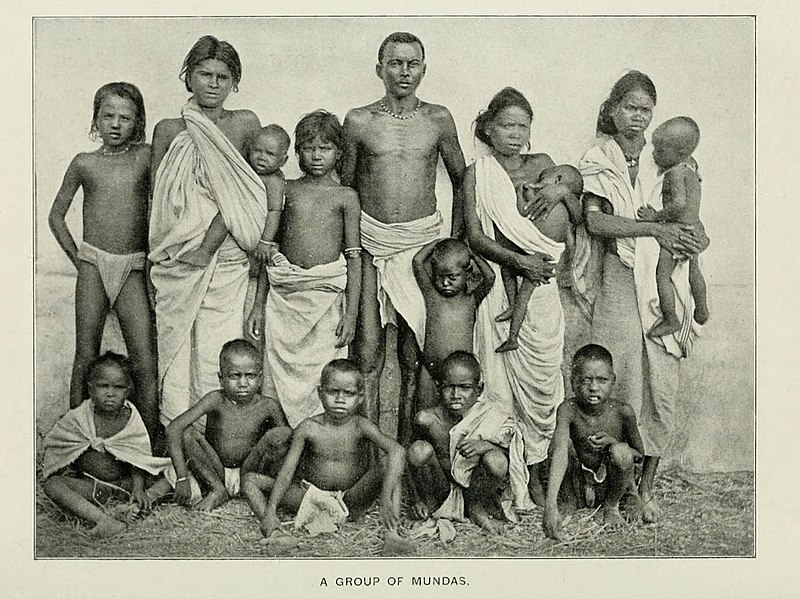
Munda Tribe Pictured in 1903
Oraon Tribe
- Second-largest tribe in Jharkhand, making up 19.86% of the state's tribal population.
- Primarily engaged in farming, forest gathering, and government jobs.
- Language: Kurukh.
- Religion: Predominantly Sarna, followed by Christianity.
- Festivals: Sarhul, Karam, and Jitia Parab.
- Cultural Traits: Known for their martial traditions and strong social organization.

Oraon tribe (Kurukh)
Ho Tribe
- Constitutes 10.74% of the tribal population in Jharkhand.
- Strongly associated with Kolhan region, particularly West Singhbhum district.
- Language: Ho (related to Mundari and Santhali).
- Religion: Sarna, Hinduism, and Christianity.
- Festivals: Mage Parab, Sohrai, and Baa Parob.
- Social System: The Ho people have one of the most organized traditional governance systems called the Munda-Manki system.
Birhor Tribe
- One of the smallest and most endangered tribes in Jharkhand, constituting just 0.12% of the state's population.
- Traditionally nomadic hunter-gatherers, relying on forest resources.
- Language: Birhor (a branch of Munda languages).
- Religion: Sarna, with strong animistic beliefs.
- Challenges: Struggling due to deforestation and loss of traditional livelihoods.
Kharia Tribe
- Comprises 2.27% of Jharkhand’s tribal population.
- Divided into three sub-groups: Dhelki Kharia, Dudh Kharia, and Hill Kharia.
- Language: Kharia.
- Religion: Sarna, with a few converted to Christianity.
- Occupation: Primarily involved in agriculture, forest collection, and government jobs.
- Festivals: Karam, Sarhul, and Jitiya.
Bhumij Tribe
- Comprising 2.42% of the tribal population, they primarily inhabit Saraikela-Kharsawan and East Singhbhum districts.
- Language: Bhumij (closely related to Mundari and Santali).
- Religion: Sarna and Hinduism.
- Traditional Occupation: Agriculture and forest-based activities.
- Festivals: Baha Parab and Sohrai.
Kharwar Tribe
- Making up 2.88% of the tribal population.
- Historically warriors, later turned to agriculture and forest activities.
- Language: Kharwari (a form of the Munda language family).
- Religion: Sarna and Hinduism.
- Festivals: Sarhul, Karma, and Sohrai.
Mal Paharia Tribe
- One of the oldest tribes, classified under Particularly Vulnerable Tribal Groups (PVTGs).
- Traditionally engaged in shifting cultivation and hunting.
- Language: Malto (a Dravidian language).
- Religion: Sarna, with some conversions to Hinduism.
- Challenges: High levels of poverty and illiteracy.
Comprehensive List of Tribes in Jharkhand
| S.No | Tribe Name | Occupation | Language | Religious Practices |
|---|---|---|---|---|
| 1 | Asur | Iron smelters, blacksmiths | Asur, Mundari | Animism, Sarna worship |
| 2 | Baiga | Shifting cultivators, forest gatherers | Baiga dialect | Animism, Hindu influences |
| 3 | Banjara | Nomadic traders, transporters | Lamani | Hinduism, Tribal traditions |
| 4 | Bathudi | Agriculture | Odia, Mundari | Hinduism, Indigenous beliefs |
| 5 | Bedia | Agriculture, folk performers | Bedia dialect | Hinduism, Animism |
| 6 | Bhumij | Agriculture, Artisans | Bhumij, Santali, Mundari | Sarnaism, Singbonga worship |
| 7 | Binjhia | Agriculture, Artisans | Binjhia, Hindi | Animism, Hindu influences |
| 8 | Birhor | Nomadic hunting-gathering | Birhor dialect | Nature worship |
| 9 | Birjia | Hunting, forest gathering | Nagpuri, Sadri | Animism, Ancestral worship |
| 10 | Chero | Farmers, Landowners | Chero, Hindi | Hinduism, Sarna worship |
| 11 | Chik Baraik | Weaving, Textile work | Mundari | Hinduism, Tribal faith |
| 12 | Gond | Agriculture, Artists | Gondi | Nature worship, Phul Mata |
| 13 | Gorait | Agriculture, Animal husbandry | Ho, Sadri | Hinduism, Sarna |
| 14 | Ho | Agriculture, Metalwork | Ho, Mundari | Sarna, Hinduism |
| 15 | Kanwar | Farming, Animal husbandry | Sadri | Hinduism, Tribal practices |
| 16 | Karmali | Iron tool making | Karmali, Hindi | Hinduism, Sarna |
| 17 | Kharia | Agricultural laborers, Forest gatherers | Kharia, Mundari | Sarna, Christianity |
| 18 | Kharwar | Farmers, Warriors | Kharwari, Hindi | Hinduism, Tribal customs |
| 19 | Khond | Agriculture, Forest protection | Khond dialect | Nature worship, Animism |
| 20 | Kisan | Agriculture, Livestock farming | Sadri, Kurukh, Nagpuri | Hinduism, Sarna worship |
| 21 | Kora | Agriculture, Laborers | Kora, Santali | Hinduism, Animism |
| 22 | Kol | Agriculture, Artisans | Kol dialect | Hinduism, Sarna worship |
| 23 | Korwa | Shifting agriculture, Hunting | Korwa dialect | Sarna, Animism |
| 24 | Lohra | Blacksmiths, Tool makers | Hindi, Sadri | Hinduism, Sarna |
| 25 | Mahli | Bamboo handicrafts, Basket weaving | Mahli dialect | Sarna, Hinduism |
| 26 | Mal Paharia | Shifting agriculture, Forest dwellers | Mal Paharia dialect | Animism, Hinduism |
| 27 | Munda | Agriculture, Rebels | Mundari | Sarna, Christianity |
| 28 | Oraon | Farming, Folk artists | Kurukh, Sadri | Sarna, Christianity |
| 29 | Parhaiya | Agriculture, Forest-based livelihoods | Parhaiya dialect | Animism, Hinduism |
| 30 | Santhal | Agriculture, Warriors | Santali | Sarna, Hinduism |
| 31 | Sauria Paharia | Shifting cultivators, Gatherers | Paharia dialect | Animism, Nature worship |
| 32 | Savar | Hunting, Gathering | Savar dialect | Nature worship, Animism |
Tribes of Jharkhand: Census 2011 Analysis
Jharkhand, one of India’s most tribal-dominated states, is home to 8,645,042 Scheduled Tribe (ST) individuals, comprising 26.21% of the state’s total population. The tribal demographic distribution is crucial in understanding Jharkhand’s socio-economic landscape, cultural heritage, and administrative policies.

ST Population Ranking
Jharkhand ranks 6th among all Indian states and union territories in terms of absolute Scheduled Tribe (ST) population and 10th in percentage share of the tribal population to the total population of the state.
Growth Rate of Tribes in Jharkhand
- The growth rate of Tribes of Jharkhand from 1991 to 2001 was 17.3%, which is lower than the overall state population growth rate of 23.3%.
- This decline highlights factors such as urban migration, economic challenges, and developmental policies that have influenced tribal population trends.
Rural-Urban Distribution
- 91.7% of Tribes of Jharkhand population lives in rural areas, making them one of the most rural-dominated tribal populations in India.
- The low urbanization rate among Jharkhand’s STs is linked to limited employment opportunities, land-based livelihood dependence, and cultural attachment to ancestral lands.
District-wise Tribal Population Distribution
The tribal population in Jharkhand is not evenly distributed across all districts. Some districts have high tribal concentrations, while others have significantly fewer ST populations.
| District | % of Total District Population (STs) | Major Tribes |
|---|---|---|
| Gumla | 68.94% | Oraon, Munda, Kharia |
| West Singhbhum | 67.31% | Ho, Munda, Santhal |
| Lohardaga | 56.89% | Oraon, Munda |
| Pakur | 42.1% | Santhal, Paharia |
| Ranchi | 35.76% | Oraon, Munda, Kharia |
- Gumla has the highest tribal concentration, with nearly 69% of the district’s population belonging to Scheduled Tribes.
- West Singhbhum follows closely, housing a large Ho and Munda tribal population.
- Lohardaga and Pakur also have significant tribal presence, with Oraon and Santhal tribes being dominant.
| District | % of Total District Population (STs) |
|---|---|
| Koderma | 0.96% |
| Chatra | 4.37% |
- Koderma has the
Major Tribes of Jharkhand
Jharkhand is home to 32 recognized Scheduled Tribes, each with its unique culture, language, and traditions. The major tribes, constituting the bulk of the tribal population, are Santhal, Oraon, Munda, and Ho. Other significant tribes include Kharia, Bhumij, Lohra, Chero, Gond, and Kisan.
1. Santhal
- Population Share: The largest tribal group in Jharkhand, comprising over 34% of the total tribal population.
- Geographical Distribution: Primarily concentrated in the Santhal Pargana division (Dumka, Godda, Sahibganj, Pakur, Jamtara, Deoghar), and also found in East Singhbhum, Hazaribagh, and Giridih.
- Culture & Livelihood: Predominantly agriculturalists. Known for their vibrant culture, rich oral traditions, music, and dance (e.g., Dahar, Lagre). Their traditional religion is Sarnaism, worshipping nature.
- Language: Santhali, which has its own script called 'Ol Chiki', recognized under the Eighth Schedule of the Indian Constitution.
2. Oraon (Kurukh)
- Population Share: The second largest tribe, making up about 19.8% of the tribal population.
- Geographical Distribution: Found mainly in the Chotanagpur plateau region, particularly in Ranchi, Lohardaga, Gumla, Latehar, and Simdega districts.
- Culture & Livelihood: Primarily settled agriculturists. Known for their 'Dhumkuriya' (youth dormitory) system, which plays a crucial role in their social and cultural education. They also follow Sarnaism.
- Language: Kurukh, a Dravidian language.
3. Munda
- Population Share: The third largest tribe, constituting approximately 14.8% of the tribal population.
- Geographical Distribution: Concentrated in Ranchi, West Singhbhum, Gumla, Simdega, and Khunti districts.
- Culture & Livelihood: Known for their 'Khuntkatti' system of land ownership (joint ownership by the clan). Their traditional burial grounds are called 'Sasan Diri'. They have a rich heritage of folk songs and dances.
- Language: Mundari, an Austroasiatic language.
4. Ho
- Population Share: The fourth largest tribe, accounting for about 10.5% of the tribal population.
- Geographical Distribution: Predominantly found in the Kolhan region, especially in West Singhbhum, Seraikela-Kharsawan, and East Singhbhum districts.
- Culture & Livelihood: Primarily agriculturists. Their village dancing ground is known as 'Akhara'. They also follow Sarnaism.
- Language: Ho, an Austroasiatic language.
5. Kharia
- Population Share: A significant tribe with distinct sub-groups.
- Geographical Distribution: Found in Gumla, Simdega, Ranchi, and West Singhbhum districts.
- Culture & Livelihood: Divided into three main sub-groups: Hill Kharia (traditional hunters and gatherers), Dhelki Kharia (settled agriculturists), and Dudh Kharia (more advanced agriculturists).
- Language: Kharia, an Austroasiatic language.
Particularly Vulnerable Tribal Groups (PVTGs) in Jharkhand
Jharkhand is home to 9 out of the 75 Particularly Vulnerable Tribal Groups (PVTGs) identified in India. These groups are characterized by pre-agricultural level of technology, stagnant or declining population, extremely low literacy rates, and a subsistence level of economy. The PVTGs in Jharkhand are:
- Asur: Known for traditional iron smelting.
- Birhor: Nomadic hunter-gatherers, known for rope making from 'Chop' fibre.
- Birajia: Primarily shifting cultivators and forest product gatherers.
- Korwa: Shifting cultivators and forest dwellers.
- Mal Paharia: Practise shifting cultivation (Jhum) and forest gathering.
- Parhaiya: Forest dwellers, dependent on forest produce and hunting.
- Sauria Paharia: Practise 'Kurwa' (shifting cultivation) on hill slopes.
- Savar: Traditionally associated with snake charming and forest produce.
- Hill Kharia: A sub-group of Kharia, known for hunting and gathering.
Government Initiatives for Tribal Welfare in Jharkhand
Both the Central and State governments have implemented various policies and schemes to uplift the tribal communities, protect their rights, and preserve their unique culture.
- Constitutional Provisions:
- Article 342: Empowers the President to specify Scheduled Tribes.
- Article 46: Directs the State to promote the educational and economic interests of STs and protect them from social injustice and all forms of exploitation.
- Fifth Schedule: Provides for the administration and control of Scheduled Areas and Scheduled Tribes in states other than Assam, Meghalaya, Tripura, and Mizoram. Jharkhand falls under the Fifth Schedule.
- Tribal Advisory Council (TAC): Established in Fifth Schedule areas to advise the Governor on matters pertaining to the welfare and advancement of STs.
- Panchayats (Extension to Scheduled Areas) Act (PESA), 1996: Extends the provisions of Part IX of the Constitution relating to Panchayats to the Scheduled Areas, empowering Gram Sabhas with significant powers over natural resources, minor forest produce, and local development.
- Forest Rights Act (FRA), 2006: Recognizes and vests forest rights and occupation in forest land to forest dwelling Scheduled Tribes and other traditional forest dwellers.
- Eklavya Model Residential Schools (EMRS): Scheme to provide quality middle and high-level education to ST children in remote areas.
- Scholarship Schemes: Various pre-matric and post-matric scholarship schemes for ST students.
- Pradhan Mantri Van Dhan Yojana (PMVDY): A market-linked tribal entrepreneurship development program for value addition to Minor Forest Produce (MFP).
- Jharkhand Tribal Empowerment and Livelihood Project (JTELP): A state-specific initiative focusing on sustainable livelihoods and food security for tribal households.
- Birsa Harit Gram Yojana: A scheme aimed at creating livelihood opportunities through horticulture and afforestation in tribal areas.
- Jharkhand State Tribal Cooperative Development Corporation Ltd. (JSTCDC): Works for the economic development of tribals through various schemes and marketing of tribal products.
Challenges Faced by Tribal Communities in Jharkhand
Despite numerous initiatives, tribal communities in Jharkhand continue to face significant challenges:
- Land Alienation and Displacement: Large-scale displacement due to mining projects, industrialization, and dam construction without adequate rehabilitation.
- Loss of Livelihoods: Deforestation and restricted access to forest resources impact traditional livelihoods based on forest produce and shifting cultivation.
- Poverty and Malnutrition: High incidence of poverty, food insecurity, and malnutrition, especially among PVTGs.
- Lack of Education and Healthcare: Low literacy rates, particularly among women, and inadequate access to quality healthcare services in remote tribal areas.
- Cultural Erosion: Impact of modernization, migration, and external influences leading to the erosion of traditional languages, customs, and social structures.
- Exploitation: Vulnerability to exploitation by moneylenders, middlemen, and land grabbers.
- Naxalism: Tribal areas are often affected by left-wing extremism, disrupting development and creating insecurity.
How many Scheduled Tribes are recognized in Jharkhand?
There are 32 recognized Scheduled Tribes in Jharkhand.
Which is the largest tribal group in Jharkhand?
The Santhal tribe is the largest tribal group in Jharkhand, comprising over 34% of the total tribal population.
What are PVTGs, and how many are there in Jharkhand?
PVTGs (Particularly Vulnerable Tribal Groups) are sub-groups among Scheduled Tribes that are more vulnerable due to their pre-agricultural technology, low literacy, and declining population. Jharkhand has 9 recognized PVTGs.
What is the significance of the Fifth Schedule for Jharkhand's tribal areas?
The Fifth Schedule of the Indian Constitution provides for the administration and control of Scheduled Areas and Scheduled Tribes in Jharkhand, granting special powers to the Governor and establishing Tribal Advisory Councils to protect tribal interests.
Source: LearnPro Editorial | Environmental Ecology | Published: 22 February 2025 | Last updated: 12 March 2026
About LearnPro Editorial Standards
LearnPro editorial content is researched and reviewed by subject matter experts with backgrounds in civil services preparation. Our articles draw from official government sources, NCERT textbooks, standard reference materials, and reputed publications including The Hindu, Indian Express, and PIB.
Content is regularly updated to reflect the latest syllabus changes, exam patterns, and current developments. For corrections or feedback, contact us at admin@learnpro.in.