
 Forest Services
Introduction to Geography Syllabus for UPSC
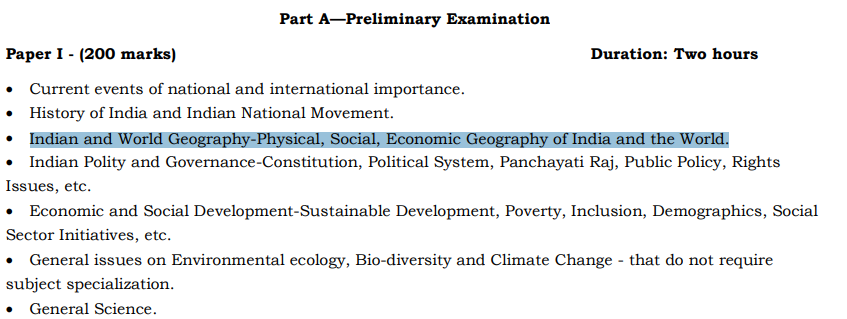
The Geography syllabus for UPSC Civil Services Examination is divided between the Preliminary Examination (GS Paper I) and the Mains Examination (GS Paper I and Optional Paper I & II). The syllabus covers Physical Geography, Human Geography, Economic Geography, Environmental Geography, and Indian Geography.
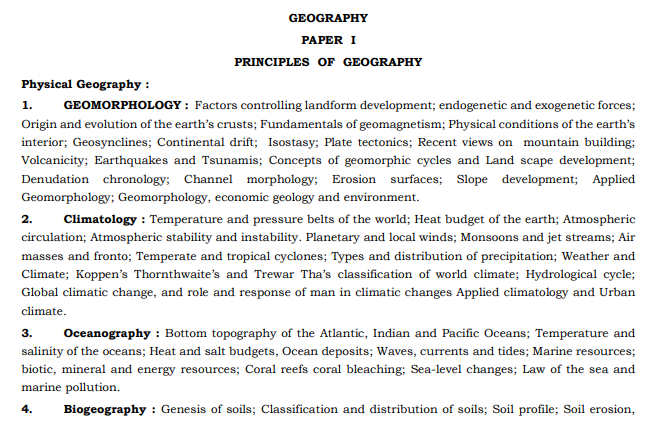
Click here for Geography optional Syllabus
Geography Syllabus for UPSC Prelims (General Studies Paper I)
The Prelims syllabus focuses on basic concepts of geography and the geographical features of India and the world.
Geography Syllabus Prescribed by UPSC
1. Physical Geography
| Main Topic | Subtopics | Micro-Topics |
|---|---|---|
| Earth’s Structure & Composition | Structure of the Earth: Crust, Mantle, Core | Composition of crust, mantle materials, inner and outer core differences |
| Geological Time Scale | Precambrian, Paleozoic, Mesozoic, Cenozoic eras | |
| Plate Tectonics & Earthquakes | Theory of Plate Tectonics | Divergent, Convergent, and Transform boundaries |
| Continental Drift Theory | Wegener’s theory, evidence of continental drift | |
| Earthquakes: Causes, Types, Measurement | Seismic waves (P, S, L waves), Richter Scale, Seismographs | |
| Earthquake Zones in the World and India | Himalayan belt, Indo-Gangetic plain, Deccan plateau seismicity | |
| Volcanism | Types of Volcanoes | Shield, Composite, Cinder Cone, Lava Domes |
| Distribution of Volcanoes | Pacific Ring of Fire, Mediterranean belt | |
| Volcanic Landforms | Calderas, Lava Plateaus, Volcanic Islands | |
| Landforms & Their Evolution | Weathering & Erosion Processes | Mechanical, Chemical, Biological weathering |
| Fluvial, Aeolian, Glacial, and Coastal Landforms | River valleys, Sand dunes, U-shaped valleys, Sea arches | |
| Cycle of Erosion Models | Davisian Model, Penck’s Model, King’s Model | |
| Climatology | Solar Radiation and Heat Balance | Insolation, Albedo, Greenhouse Effect |
| Temperature Distribution | Isotherms, Heat Islands, Temperature Inversions | |
| Atmospheric Pressure and Winds | Pressure belts, Trade winds, Westerlies, Jet Streams | |
| Precipitation: Types & Distribution | Convectional, Orographic, Frontal precipitation | |
| Global Climatic Zones | Koppen Classification, Thornthwaite’s Classification | |
| Oceanography | Ocean Currents | Warm & Cold Currents, Gulf Stream, Kuroshio Current |
| Tides and Waves | Spring and Neap Tides, Tsunamis, Rogue Waves | |
| Coral Reefs and Marine Ecosystems | Fringing, Barrier, and Atoll Reefs | |
| Ocean Floor Features | Continental Shelf, Slope, Abyssal Plains, Trenches |
2. Indian Geography
| Main Topic | Subtopics | Micro-Topics |
|---|---|---|
| Physical Features | Himalayas: Structure & Formation | Greater, Lesser, Shivalik ranges, Trans-Himalayas |
| Peninsular Plateau: Features | Deccan Plateau, Aravalli Hills, Western and Eastern Ghats | |
| Coastal Plains and Islands | Eastern & Western Coastal Plains, Andaman & Nicobar, Lakshadweep Islands | |
| River Systems & Water Resources | Himalayan Rivers | Indus, Ganga, Brahmaputra river systems |
| Peninsular Rivers | Godavari, Krishna, Kaveri, Narmada, Tapi | |
| Inland Drainage & Watershed Management | Sambhar Lake, Rann of Kutch, River linking projects | |
| Groundwater and Irrigation | Types of irrigation: Canal, Drip, Sprinkler | |
| Climate, Weather Patterns & Monsoons | Indian Monsoon System | Southwest & Northeast Monsoons, Western Disturbances |
| Climatic Regions of India | Koppen Classification in India, Seasonal Variations | |
| Cyclones, Floods, and Droughts | Cyclone-prone areas, flood management, drought mitigation | |
| Natural Vegetation & Wildlife | Forest Types in India | Tropical Rainforests, Deciduous, Thorn, Montane, Tidal Forests |
| Wildlife Sanctuaries & National Parks | Project Tiger, Project Elephant, Biosphere Reserves | |
| Biodiversity Hotspots | Western Ghats, Indo-Burma, Himalayas | |
| Soil Types & Distribution | Major Soil Types | Alluvial, Black, Red, Laterite, Desert, Mountain Soils |
| Soil Erosion & Conservation | Causes of erosion, watershed management, soil conservation techniques | |
| Soil Fertility & Productivity | Organic farming, Green Revolution impact on soil |
3. World Geography
| Main Topic | Subtopics | Micro-Topics |
|---|---|---|
| Continents & Countries | Physical Features of Continents | Mountains (Andes, Rockies), Deserts (Sahara, Gobi), Rivers (Amazon, Nile) |
| Important Countries and Capitals | Geopolitical significance of key countries | |
| Major Geopolitical Regions | Middle East, Southeast Asia, Europe, Sub-Saharan Africa | |
| Latitude, Longitude & Time Zones | Latitude & Longitude System | Equator, Tropics, Prime Meridian, International Date Line |
| Time Zones & Standard Time | GMT, IST, Daylight Saving Time, Time Zone Calculations | |
| Earth’s Rotation and Revolution | Effects on seasons, time differences | |
| Important Geophysical Phenomena | Cyclones, Typhoons, and Hurricanes | Formation, Classification, Impact Regions |
| Earthquakes and Tsunamis | Ring of Fire, Richter Scale, Seismic Zones | |
| Volcanic Eruptions & Distribution | Active, Dormant, Extinct volcanoes globally | |
| Global Climatic Changes | El Niño, La Niña, Jet Streams |
4. Human & Economic Geography
| Main Topic | Subtopics | Micro-Topics |
|---|---|---|
| Population & Demographic Trends | World Population Growth | Demographic Transition Model, Global Population Distribution |
| Population Density and Distribution | Factors influencing population density | |
| Age-Sex Structure and Population Pyramids | Types of pyramids: Expansive, Constrictive, Stationary | |
| Migration & Urbanization | Types of Migration | Internal vs International, Voluntary vs Forced Migration |
| Causes and Effects of Migration | Push & Pull factors, Brain Drain, Refugee crisis | |
| Urbanization Trends | Megacities, Urban Sprawl, Smart Cities | |
| Economic Activities | Primary, Secondary, Tertiary Sectors | Agriculture, Mining, Manufacturing, Services |
| Agricultural Geography | Types of farming: Subsistence, Commercial, Plantation | |
| Industrial Geography | Factors influencing industrial location, Major industrial regions | |
| Natural Resources & Distribution | Distribution of Resources | Coal, Oil, Natural Gas, Minerals globally and in India |
| Renewable vs Non-Renewable Resources | Solar, Wind, Hydro, Fossil Fuels | |
| Resource Conservation | Sustainable development, Circular economy |
5. Environmental Geography
| Main Topic | Subtopics | Micro-Topics |
|---|---|---|
| Biodiversity & Conservation | Levels of Biodiversity | Genetic, Species, Ecosystem Biodiversity |
| Conservation Methods | In-situ & Ex-situ Conservation, Protected Areas | |
| International Agreements | Convention on Biological Diversity (CBD), Ramsar Convention, CITES | |
| Environmental Degradation & Pollution | Types of Pollution | Air, Water, Soil, Noise Pollution |
| Causes and Effects of Pollution | Industrialization, Urbanization, Deforestation | |
| Environmental Movements | Chipko Movement, Silent Valley, Narmada Bachao Andolan | |
| Climate Change & Global Warming | Greenhouse Effect & Global Warming | Causes, Consequences, Global Temperature Trends |
| International Initiatives | Kyoto Protocol, Paris Agreement, IPCC Reports | |
| Climate Change Mitigation | Carbon Sequestration, Renewable Energy | |
| Disaster Management | Types of Disasters | Natural: Earthquakes, Floods, Cyclones; Man-made: Industrial Accidents |
| Disaster Preparedness & Mitigation | NDMA Guidelines, Early Warning Systems, Rehabilitation Policies | |
| International Frameworks | Sendai Framework for Disaster Risk Reduction |
How is the Prelims Syllabus Different from the Mains Syllabus ?
The geography syllabus for UPSC is a crucial component of both the Preliminary and Mains stages of the Civil Services Examination. However, the focus, depth, and approach differ significantly between the two. Let’s break down these differences in simple terms to help you understand how to prepare for each stage effectively.
Geography Syllabus Prescribed by UPSC
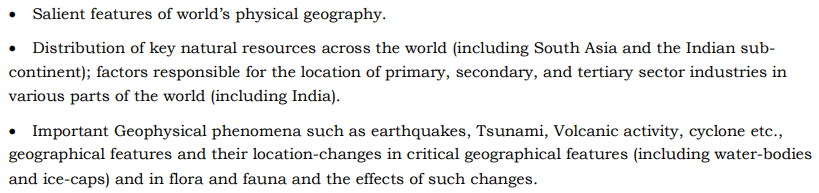
Geography Syllabus for UPSC mains
1. Objective vs. Descriptive Nature
- Prelims:
The Prelims exam is objective in nature, meaning you will answer multiple-choice questions (MCQs). The geography syllabus for UPSC Prelims focuses on basic concepts, facts, and general knowledge. It tests your ability to quickly recall information and apply it to factual questions.Example:
Which of the following rivers originates from the Amarkantak plateau?- Narmada
- Godavari
- Krishna
- Kaveri
(Answer: Narmada)
- Mains:
The Mains exam is descriptive and requires you to write detailed answers in an analytical manner. The geography syllabus for UPSC Mains goes deeper into concepts and expects you to link theories with current affairs, draw diagrams/maps, and critically analyze geographical issues.Example:
Discuss the role of ocean currents in influencing global climate patterns.
2. Breadth vs. Depth of Knowledge
- Prelims:
The syllabus is broad but not very deep. It covers a wide range of topics like Physical Geography, Indian Geography, and World Geography, but the focus is on basic understanding rather than detailed analysis.Prelims Topics Include:- Earth’s structure, plate tectonics, and earthquakes
- Indian rivers, climate, soil types
- World continents, latitude & longitude, time zones
- Environmental issues like climate change and biodiversity
- Mains:
The syllabus demands in-depth knowledge and the ability to interlink topics. The geography syllabus for UPSC Mains includes not only the physical and environmental aspects but also economic, social, and political dimensions of geography.Mains Topics Include:- Detailed study of geomorphic processes and landform development
- Climatology and oceanography in relation to human activities
- Industrial location theories and resource distribution
- Regional development planning and disaster management
3. Static vs. Analytical Approach
- Prelims:
Focuses mainly on static knowledge—information that doesn’t change over time. It emphasizes definitions, locations, and factual data. While some current affairs are integrated (like environmental treaties), the majority of questions are concept-based.Example:
What type of soil is predominant in the Deccan plateau?
(Answer: Black Soil) - Mains:
Requires a dynamic and analytical approach. You need to relate current events with geographical concepts and explain the cause-effect relationships. The ability to critically analyze issues and propose sustainable solutions is key.Example:
Analyze the impact of climate change on the frequency and intensity of tropical cyclones in India.
4. Use of Maps and Diagrams
- Prelims:
While map-based questions are common, you are not required to draw maps. Instead, you need to identify locations, recognize features, and answer factual questions based on maps.Example:
Which of the following states does the Tropic of Cancer not pass through? - Mains:
Drawing maps and diagrams is essential for scoring high marks. The geography syllabus for UPSC Mains expects you to illustrate your answers with India and world maps, flowcharts, and climatic graphs to enhance clarity and presentation.Example:
Explain the distribution of iron ore deposits in India with the help of a suitable map.
5. Integration of Current Affairs
- Prelims:
Current affairs are relevant but mostly in areas like environmental geography—for instance, recent climate agreements or biodiversity hotspots declared under international conventions.Example:
Which of the following countries recently hosted the COP27 Climate Summit? - Mains:
The geography syllabus for UPSC Mains demands a deep connection with current affairs. Topics like climate change, urbanization trends, disaster management, and regional planning must be answered with current data and recent examples.Example:
Evaluate the impact of the recent urban flooding in Bengaluru on infrastructure and regional planning.
Key Differences Summarized
| Aspect | Prelims (Objective) | Mains (Descriptive) |
|---|---|---|
| Nature of Questions | Multiple-choice, fact-based | Analytical, descriptive, and essay-style |
| Depth of Knowledge | Broad understanding of basic concepts | In-depth analysis and interlinking of concepts |
| Approach | Static and factual | Dynamic, analytical, and current affairs-oriented |
| Use of Maps/Diagrams | Identify locations, no need to draw | Drawing maps and diagrams is essential |
| Current Affairs | Limited to environmental treaties and global geography issues | Integrated with physical, human, and economic geography |
Breakdown of the Geography syllabus for UPSC Mains (General Studies Paper I)
1. Physical Geography
| Main Topics | Subtopics | Details / Focus Areas |
|---|---|---|
| Salient Features of the World’s Physical Geography | Major Landforms and Physical Features | Mountains, Plateaus, Plains, Deserts, River Systems, Lakes, Valleys |
| Continents and Ocean Basins | Continental Drift, Plate Tectonics, Structure of Ocean Basins | |
| Major Biomes and Ecosystems | Tropical Rainforests, Deserts, Tundra, Grasslands, Coral Reefs | |
| Geomorphic Processes and Landforms | Endogenic Processes | Volcanism, Earthquakes, Plate Tectonics, Mountain Building |
| Exogenic Processes | Weathering, Erosion, Mass Wasting, Deposition | |
| Landforms Created by Fluvial, Aeolian, Glacial, and Coastal Processes | River Valleys, Sand Dunes, Glacial Moraines, Sea Cliffs, and Beaches | |
| Climatology and Climatic Regions | Structure and Composition of the Atmosphere | Troposphere, Stratosphere, Mesosphere, Thermosphere |
| Temperature and Pressure Distribution | Isotherms, Atmospheric Pressure Belts, Temperature Inversions | |
| Winds and Air Circulation | Trade Winds, Westerlies, Jet Streams, Monsoon Circulation | |
| Precipitation and Cloud Formation | Types of Rainfall (Convectional, Orographic, Frontal), Cloud Types | |
| Classification of Climates | Köppen’s Climatic Classification, Thornthwaite’s Classification | |
| Global Warming and Climate Change | Greenhouse Effect, Carbon Cycle, Impacts on Weather Patterns | |
| Oceanography: Ocean Currents and Marine Resources | Ocean Circulation Patterns | Warm and Cold Currents (Gulf Stream, Kuroshio Current), Thermohaline Circulation |
| Tides, Waves, and Marine Ecosystems | Tidal Energy, Tsunamis, Coral Reefs, Marine Biodiversity | |
| Ocean Resources | Fisheries, Minerals from Ocean Beds, Offshore Oil and Gas | |
| Ocean-Atmosphere Interactions | El Niño, La Niña, Indian Ocean Dipole |
2. Indian Geography
| Main Topics | Subtopics | Details / Focus Areas |
|---|---|---|
| Distribution of Key Natural Resources across India and the World | Mineral Resources | Iron, Coal, Bauxite, Manganese, Oil and Gas Fields, Uranium Distribution |
| Forest Resources | Types of Forests in India, Timber Resources, Conservation Measures | |
| Water Resources | River Systems, Groundwater, Major Dams and Reservoirs, Water Conservation Techniques | |
| Agricultural Resources | Major Crops, Agricultural Regions, Green Revolution Impacts | |
| Energy Resources | Renewable and Non-renewable Resources, Solar, Wind, Hydropower, Thermal Power Plants | |
| Factors Responsible for the Location of Primary, Secondary, and Tertiary Sector Industries | Primary Sector | Factors Affecting Agricultural and Mining Locations |
| Secondary Sector | Industrial Location Theories (Weber’s Theory), Industrial Corridors, SEZs, Clusters | |
| Tertiary Sector | Service Sector Growth, IT Hubs, Financial Centers, Tourism Industry | |
| Regional Disparities in Industrial Development | Industrially Developed vs. Backward Regions, Balanced Regional Development Strategies | |
| Earthquakes, Tsunamis, Cyclones, and Other Natural Disasters in India | Earthquake Zones | Seismic Zones of India, Himalayan Earthquakes, Indo-Gangetic Plain Vulnerabilities |
| Tsunamis and Cyclonic Activity | Coastal Vulnerability, Eastern and Western Coastal Cyclones, Disaster Preparedness | |
| Floods and Droughts | Flood-Prone Areas, Riverine Floods, Drought-Prone Regions, Impact on Agriculture and Livelihoods | |
| Landslides and Avalanches | Himalayan and Western Ghats Vulnerabilities, Mitigation Strategies | |
| Important Geophysical Phenomena | Monsoon Variability | Indian Monsoon Patterns, El Niño Effect, Break Monsoon Phenomenon |
| Western Disturbances and Local Winds | Impact on Northern Plains, Loo Winds, Mango Showers | |
| Desertification and Coastal Erosion | Thar Desert Dynamics, Coastal Degradation in Gujarat, Kerala |
3. Human Geography
| Main Topics | Subtopics | Details / Focus Areas |
|---|---|---|
| Population Distribution and Demographic Attributes | Global and Indian Population Distribution | Population Density Patterns, Demographic Dividends, Factors Affecting Population Growth |
| Age-Sex Structure and Demographic Transition | Population Pyramids, Dependency Ratios, Demographic Transition Model (DTM) | |
| Literacy and Education Patterns | Regional Disparities in Literacy, Female Literacy Rates, Impact of Education on Development | |
| Health and Mortality Rates | Infant Mortality, Life Expectancy, Healthcare Access, Maternal Mortality | |
| Urbanization, Migration, and Settlement Patterns | Urbanization Trends in India and the World | Growth of Megacities, Urban Sprawl, Slums and Informal Settlements, Smart Cities Mission |
| Rural-Urban Migration | Causes (Push & Pull Factors), Consequences, Brain Drain, Remittances | |
| Settlement Patterns | Types of Rural and Urban Settlements, Dispersed vs. Clustered Settlements | |
| Urban Planning and Development | Master Plans, Urban Governance Models, Infrastructure Development, AMRUT Mission | |
| Regional Planning and Development | Regional Disparities | Causes of Regional Imbalances, Policies for Balanced Regional Development |
| Planning Regions in India | Five-Year Plans, Regional Development Authorities, NITI Aayog’s Role | |
| Special Economic Zones (SEZs) and Industrial Corridors | DMIC (Delhi-Mumbai Industrial Corridor), Chennai-Bengaluru Corridor | |
| Sustainable Development and Regional Planning | Role of Geography in Sustainable Planning, SDGs Implementation in Indian Regions |
Geography Notes for UPSC
- Introduction to the Studies of Earth
- The Solar System: A Fascinating Journey Through Space 4.5 Billion years in past
- Continental Drift Theory (CDT), Plate Boundaries, Fold Mountain Orogeny
- Cosmic Microwave Background Radiation: 13.8 Billion years in past
Frequently Asked Questions
What are the main topics covered in the Geography syllabus for the UPSC Civil Services Examination?
The Geography syllabus for the UPSC Civil Services Examination covers five main topics: Physical Geography, Human Geography, Economic Geography, Environmental Geography, and Indian Geography. Each of these categories encompasses various subtopics that delve into both foundational concepts and specific details relevant to the subject.
How does the Geography syllabus differ between the Preliminary Examination and the Mains Examination?
The Geography syllabus for the Preliminary Examination focuses primarily on basic concepts and geographical features of India and the world. In contrast, the Mains Examination includes more detailed elements, covering extensive topics in both General Studies Paper I and the Optional Paper I & II, making it more comprehensive.
What specific areas are included under the Physical Geography subtopic in the UPSC syllabus?
Under Physical Geography, the UPSC syllabus includes subtopics such as Earth's Structure and Composition, Plate Tectonics and Earthquakes, Volcanism, Weathering and Erosion, and Climatology. These areas emphasize understanding the planet's physical features, processes, and systems that operate on Earth.
What is the significance of the Indian Geography section in the UPSC syllabus?
The Indian Geography section is significant because it covers essential aspects of India's physical features, climate, river systems, vegetation, and soils. This knowledge is critical not only for understanding India's demographics and natural resources but also for addressing regional socio-economic issues that are relevant for civil services.
What are some key micro-topics included under oceanography in the Preliminary syllabus?
Key micro-topics under oceanography in the UPSC Preliminary syllabus include ocean currents, tides and waves, coral reefs and marine ecosystems, and features of the ocean floor. Understanding these concepts is essential for analyzing global climatic patterns and their implications for the environment and human activity.
About LearnPro Editorial Standards
LearnPro editorial content is researched and reviewed by subject matter experts with backgrounds in civil services preparation. Our articles draw from official government sources, NCERT textbooks, standard reference materials, and reputed publications including The Hindu, Indian Express, and PIB.
Content is regularly updated to reflect the latest syllabus changes, exam patterns, and current developments. For corrections or feedback, contact us at admin@learnpro.in.